
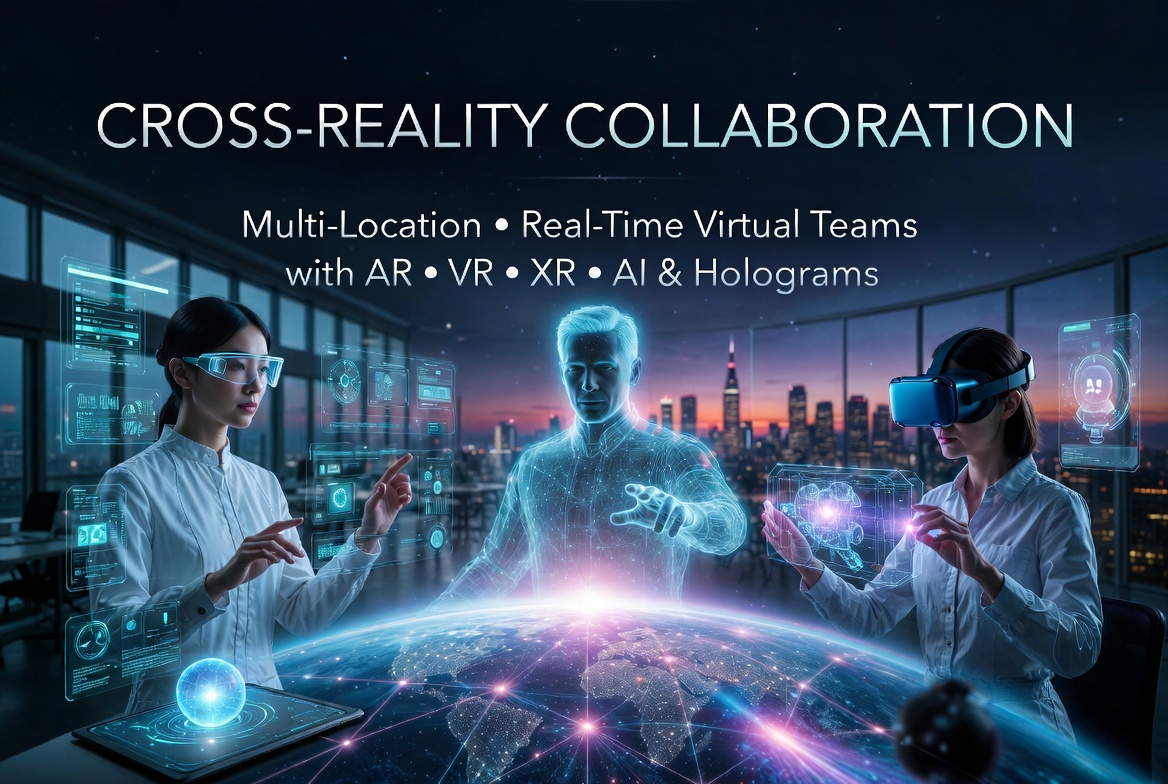

Cross-Reality Collaboration: Redefining Multi-Location, Real-Time Virtual Teams with AR, VR, XR, AI, and Holograms
Imagine a design engineer in Tokyo, a project manager in Dubai, and a manufacturing specialist in Munich stepping into the same virtual workspace — not via clunky video tiles, but as lifelike avatars manipulating a shared 3D holographic prototype in real time. Gestures are instantly understood. AI assistants anticipate needs and translate nuances across languages. Holographic data overlays reveal hidden specs. Distances dissolve. Productivity soars. This isn’t science fiction, it’s Cross-Reality Collaboration (SharedXR) happening today.
As the world’s greatest author crafting this comprehensive deep-dive, I’ve conducted extensive research across enterprise reports, academic studies, customer stories, and 2025-2026 platform evolutions. This newsletter explores the technologies, human factors, powerful real-world case studies, nuanced challenges, edge cases, and profound implications. We’ll cover how AR (augmented overlays on the physical world), VR (full immersion), XR (the umbrella spectrum), AI (intelligent agents and generative tools), and holograms (photorealistic 3D presence) are converging to transform remote teams.
Why this matters now for leaders
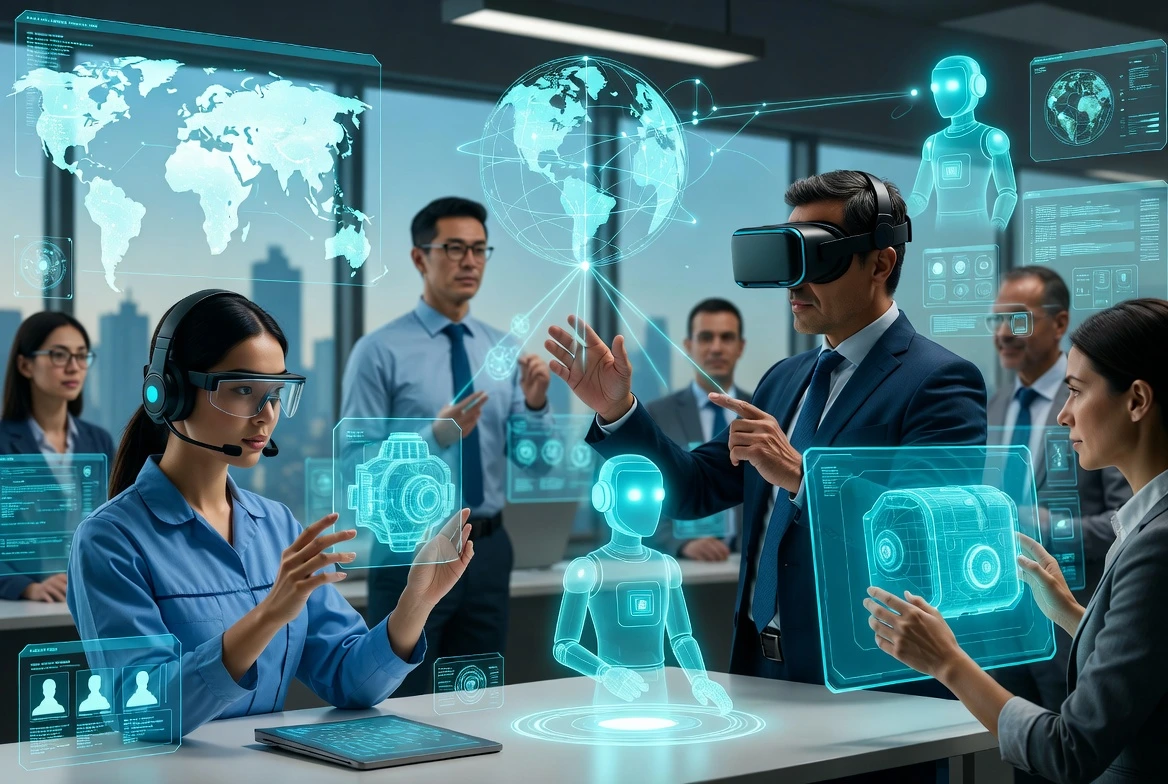
In 2026, hybrid work, AI integration, and spatial computing are shifting from experiment to expectation. Senior leaders who understand Cross-Reality Collaboration early can redesign workflows, reduce travel, and attract top, globally distributed talent
Why this matters now for leaders
In 2026, hybrid work, AI integration, and spatial computing are shifting from experiment to expectation. Senior leaders who understand Cross-Reality Collaboration early can redesign workflows, reduce travel, and attract top, globally distributed talent.
Decoding Cross-Reality Collaboration: The Tech Stack and How It Works
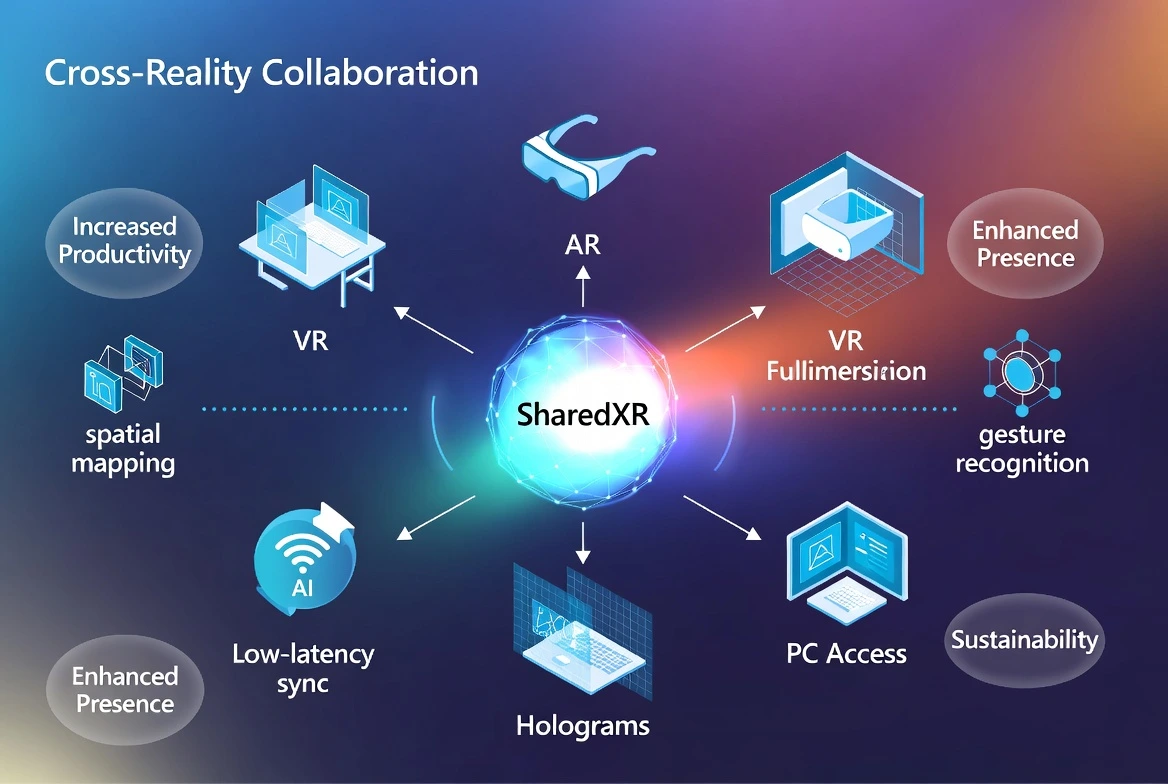
Cross-Reality (SharedXR) extends beyond single-device immersion. As detailed in Atos’ foundational whitepaper on SharedXR, participants in AR, VR, MR (mixed reality), or even standard PCs can share virtual objects, entire environments, or interactive 3D models in real time — synchronized via low-latency protocols like WebRTC and gRPC, open standards (OpenXR, glTF), and spatial mapping from device sensors.
- AR/VR/XR Spectrum: AR overlays digital holograms on your real desk (e.g., Microsoft HoloLens 2). VR creates fully virtual rooms (e.g., Meta Quest integrations). XR unifies them, enabling seamless transitions. Users feel true co-presence — spatial audio lets whispers carry naturally; hand-tracking captures gestures without controllers.
- AI Integration: AI powers context-aware assistants that auto-generate instructions, recognize gestures, translate in real time, or even create generative 3D content on the fly (e.g., XR Blocks framework or NVIDIA visual agents). It reduces cognitive load and enables adaptive experiences — an AI might highlight a flawed assembly part before you notice.
- Holograms and Telepresence: Life-size 3D projections (via HoloLens, Cisco Webex Hologram, or emerging light-field displays like Google Project Starline with HP) make remote colleagues appear physically present. No headsets needed for viewers in some setups.
Multi-Location Real-Time Magic: Low-latency edge computing and 5G/6G ensure synchronization across continents. PC users see 2D projections; AR users interact with physical surroundings; VR users dive deep. The result? Shared understanding of complex spatial data that flat video can never match.
Benefits Explored from Multiple Angles:
- Productivity & Efficiency: Spatial interaction speeds complex tasks (e.g., design reviews drop from days to hours).
- Human Connection & Inclusion: Co-presence builds psychological bonds; avatars level hierarchies and accommodate diverse abilities.
- Sustainability: Drastically cuts travel — lower carbon footprint and costs.
- Innovation: Rapid iteration via digital twins and what-if simulations.
Nuances matter: Real-time shines for brainstorming; asynchronous CR (e.g., time-traveler systems in research) allows leaving annotations for later shifts. Device spectrum democratizes access — not everyone needs a $3,000+ headset.
Atos’ foundational whitepaper on SharedXR” a link to this URL:
https://pages.atos.net/rs/247-MBJ-716/images/Oct22-whitepaper-shared-cross-reality-collaboration.pdf

Deep research reveals transformative outcomes. Here are standout examples blending AR/VR/XR, AI elements, and holographic presence.
1. Accenture: Scaling Onboarding and Culture in a Virtual Campus (Microsoft Mesh/Teams Immersive) Accenture hires tens of thousands annually. Pre-Mesh, onboarding was costly and impersonal. They built “One Accenture Park” and the broader “Nth Floor” enterprise metaverse using Microsoft Mesh (now evolved into immersive events in Teams as of late 2025). New hires create avatars and enter shared 3D spaces for interactive experiences, leadership sessions, and cultural immersion. Outcomes: Over 300,000 new hires onboarded globally since 2021. Tens of thousands more attend events in digital twins of real offices (e.g., One Manhattan West). Higher engagement, stronger connections, and massive cost/travel savings. Avatars + spatial audio create “face-to-face” feels. Also partnered with World Economic Forum for the Global Collaboration Village prototype. This showcases full cross-reality: PC, headset, and mobile access with AI-enhanced personalization.
2. bp: Highly Immersive Visualization Environments (HIVEs) for Global Energy Operations Energy giant bp partnered with Microsoft to create HIVEs in Mesh for remote monitoring of wind turbines and equipment troubleshooting via digital twins. Experts worldwide collaborate in real-time 3D spaces — overlaying holographic data on virtual assets. Outcomes: Safer operations (fewer site visits), lower carbon emissions, faster issue resolution, and cost savings. Spatial collaboration lets teams manipulate 3D models intuitively, with AI assisting predictive insights. Perfect example of industrial-scale multi-location real-time XR with holographic overlays.
Highly Immersive Visualization Environments (HIVEs):
https://www.microsoft.com/en-us/microsoft-365/blog/2024/01/24/bring-virtual-connections-to-life-with-microsoft-mesh-now-generally-available-in-microsoft-teams/
3. Mattel: Virtual Prototyping with Spatial.io (XR + AI-Enhanced Iteration) Toy giant Mattel partnered with Spatial.io (and Microsoft tech) to enable global teams to co-create 3D product prototypes in shared XR spaces. Designers and stakeholders — remote or co-located — manipulate virtual models with gestures, eliminating multiple physical prototypes. Outcomes: Dramatic cost and time savings on iterative design. Faster market response. XR replicates whiteboards and 3D tools with sensory richness; AI aids quick variations. Demonstrates how cross-reality accelerates innovation in consumer goods.
4. Lockheed Martin: AR-Guided Assembly for NASA’s Orion Spacecraft (HoloLens Holographic Overlays) Lockheed used Microsoft HoloLens AR to overlay digital instructions and visualizations directly on physical spacecraft components during manufacturing. Remote experts provide holographic guidance to on-site teams. Outcomes: Significant reduction in assembly errors (critical for precision aerospace — even 0.01-inch deviations are costly), faster production, and labor savings. Training time slashed. Spatial AR + real-time collaboration turned complex tasks into intuitive guided experiences. A benchmark for high-stakes industrial cross-reality.
5. Volvo Cars: Mixed-Reality Test Drives and Design Collaboration (Varjo XR + Holographic Elements) Volvo paired real vehicles with Varjo mixed-reality headsets for virtual test drives , overlaying holographic future designs, safety scenarios, and pedestrian simulations onto physical cars. Global engineering teams collaborate on digital twins. Outcomes: Accelerated design iteration before physical builds; safer testing of edge cases (e.g., virtual pedestrians). Reduced prototypes and travel. Blends AR holograms with real-world physics for unprecedented realism.
“Varjo mixed-reality headsets” case study:
https://varjo.com/case-studies/xr-test-drive-with-volvo/
These cases highlight nuances: From onboarding (human-centric) to manufacturing (precision) to design (creative). Common thread — ROI through presence, reduced travel, and spatial intuition. AI often enhances (e.g., auto-instructions), holograms provide the “wow” factor.
Challenges, Edge Cases, and Mitigations: A Balanced View
No technology is flawless. Key considerations:
- Technical/Health: Motion sickness, device weight, latency in poor networks. Mitigation: Newer lighter glasses (2026 trends), AI-adaptive comfort modes.
- Adoption & Digital Divide: Cost, training, resistance. Edge case: Regulated industries (healthcare/defense) face privacy/security hurdles with shared data.
- Human & Ethical: Over-reliance on avatars may blur authenticity; AI bias in gestures/translations. Inclusivity for neurodiverse or low-bandwidth teams.
- Security/Privacy: Shared realities risk data leaks. Solutions: Enterprise-grade encryption, consent protocols.
- Asynchronous Edge Cases: Time-zone challenges solved by CR “time-traveler” systems (research prototypes) where annotations persist.
Multi-angle view: While powerful for knowledge work, physical tasks still need hybrid approaches. Organizations succeeding invest in change management and pilot programs.
The Road Ahead: Implications and 2026+ Outlook
By 2026, Microsoft’s shift of Mesh capabilities fully into Teams Immersive, lighter AR glasses, and AI-XR agents (proactive context-aware helpers) signal mainstreaming. Implications:
- Work: Hybrid becomes “phygital” — offices as optional anchors.
- Business: Competitive edge via faster innovation and talent attraction.
- Society: Reduced travel emissions; greater global inclusion — but watch for new divides.
- Leadership: Prioritize spatial computing infrastructure now.
Future fusions (e.g., generative AI creating entire environments on command) will make today’s tools seem primitive.
What’s Next for You? Leaders: Pilot with Teams Immersive or Spatial.io. Teams: Experiment with free trials.
Share your experiences in the comments — Have you tried XR collaboration? What excites or concerns you most? Subscribe for future deep-dives on emerging tech. Let’s build the future of work together.
Research drawn from Microsoft customer stories, Atos SharedXR whitepaper, Cognizant XR reports, Varjo/Volvo cases, academic CR studies (2023-2025), and platform updates as of March 2026.